What is AEO? And Where to start for Business Optimisation

What Is AEO and Why Does It Matter?
With the rise of AI, we are moving into a new search landscape where people prefer to prompt and receive quick summaries than endlessly browse the web.
This shift is forcing a new type of optimisation for business content: AEO (Answer Engine Optimisation).
AEO vs SEO
AEO (Answer Engine Optimisation) = structuring content so AI tools (ChatGPT, Perplexity, Gemini, Claude) can easily select, summarise, or cite your content.
SEO (Search Engine Optimisation) = structuring content to rank higher on traditional search engine results pages.
SEO used to be the gold standard for achieving better visibility. Now, the game has changed with the introduction of AI.
Why mastering AEO beyond SEO makes sense in the emergence of AI
Large language models generate answers by predicting the next word using patterns learned from massive datasets. Because of this, LLMs favour content that is:
directly answering a question,
structured clearly, and
rich in contextual meaning, not just optimised for keywords.
This is why SEO alone doesn’t cut it anymore. SEO tends to optimise for discoverability, think metadata, keywords, backlinks. Rather than for the semantic clarity (meaning and underlying concept) that AI systems need to correctly interpret and reuse content.
Therefore, the clearer your concepts, definitions and argument structure are, the more easily AI tools can extract key points and cite you as a source.
Still Not Convinced? Here's Why You Should Bother With AEO
User behaviour is shifting fast.
AI is returning fast, concise, fully synthesised answers, and as a result, users are less motivated to sift through multiple articles to find what they need.
This means that fewer people are likely to reach your webpage directly. Unless, your content is selected or cited by AI.
Then you gain:
Visibility: you're surfaced in the AI-generated summaries that AI returns from user search.
Trust and Authority: if an AI overview includes your content, users perceive you as authoritative. Being referenced by an AI model strengthens your brand credibility, even before the user clicks through to your webpage.
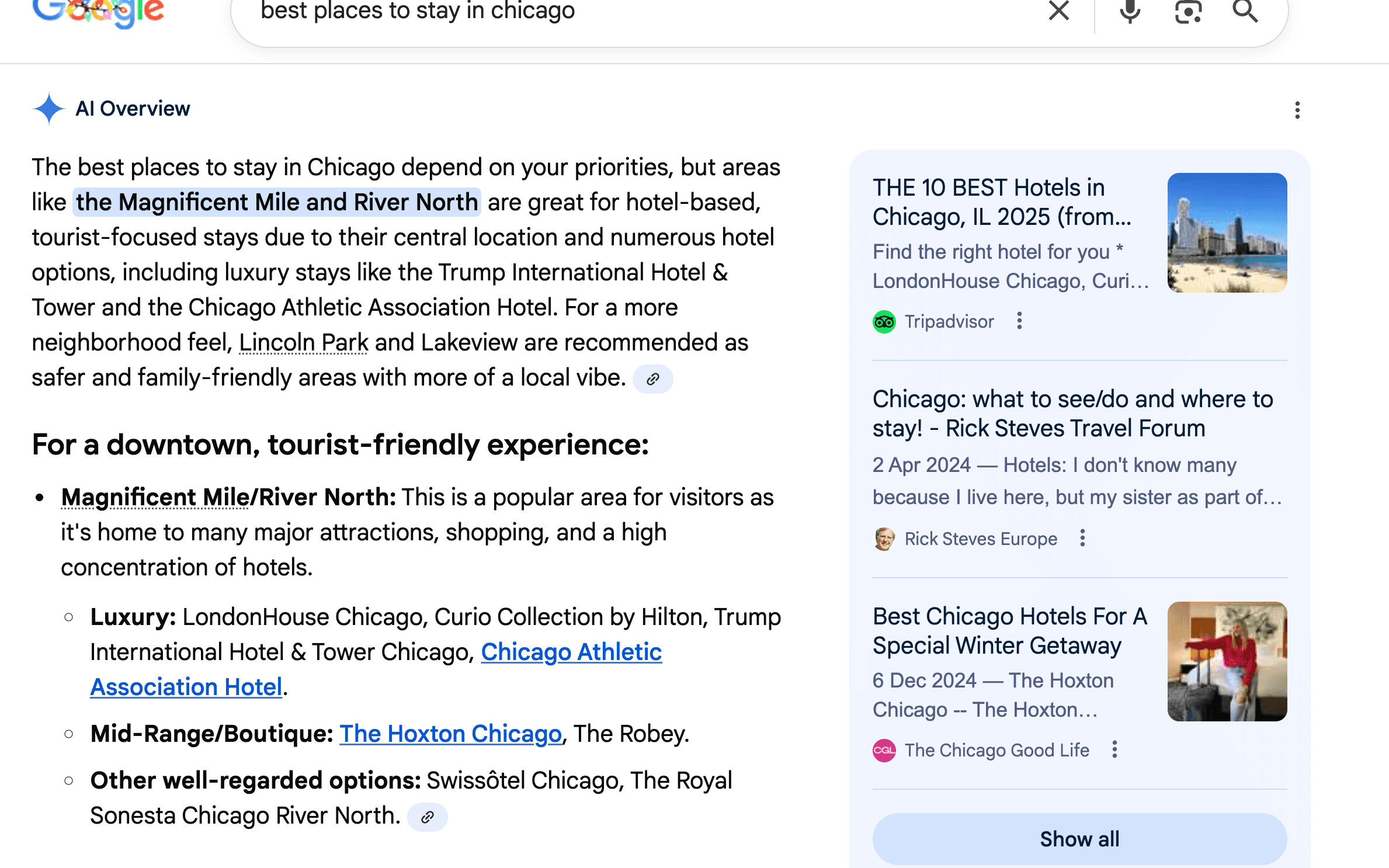
Here are 7 of the best practises for AEO (even though the rules are still not 100% clear)
Nail the copywriting fundamentals.
Clear titles and headlines. Make the purpose of your cotent explicit, provide immediate context rather than lots of jargon.
Make your audience clear by answering: Who is this for? What are you saying? Why does it matter?
Lead with definition, then explanation.
AI overviews almost always begin by defining the concept.
To improve the AI's ability to generate meaning from your content, create a cascade of what you are saying by defining core concepts before further extrapolating.
Use lists, steps, and short paragraphs.
Structured content makes extraction easier for LLMs.
Frame key sections as questions.
Users ask AI questions.
Mirror that format to maximise alignment with search intent.
Use semantic cues and connective logic.
Phrases like “In comparison…”, “This matters because…”, “A stronger approach is…” help AI understand relationships between ideas.
Also use related concepts to strengthen contextual weight:
e.g., “fire engine”, “emergency services”, “urgent response” will help the AI build a map of your underlying content meaning.
Use structured data (Schema Markup).
Helps both search engines and AI understand what your page means, not just what it contains.
Especially useful for FAQs, definitions, how-tos, and review style content.
This can be done by editing the HTML code of your webpage to basically inform the AI of what your content is. This is a whole different rabbit hole but worth it if you're interested in getting the best results.
Give your content a test run
Search the question your article answers into chat GPT and ask it to find resources. If your article/ content is returned in the search then you’ve done a good job at mastering AEO - (it's probably worth doing this in an incognito browser to get the most objective test).
If you don’t surface, then you could put your article into an LLM and ask it to optimise AEO for you.
Summary
AI is changing the game for content optimisation. AEO is here to stay, and while we still don't exactly know what the best practises are, it's worth optimising your content to ensure your business surfaces in AI search.
This ensures business visibility, authority and user trust. To get started today, use the following steps:
Ensure your content is clearly structured
Include definitions and remove waffle
Make use of lists, steps and how-tos
Frame key sections as questions
Use connecting words to articulate similar vs contrasting points
Use structured data in HTML
Feed your content back into AI to give it a test run